

Where Do Public Schools Get Their Money
Resource Equity Financial Transparency Regulatory
How are Public Schools Funded?
Understanding how dollars are allocated to different student groups across schools and modeling different scenarios for more equitable distributions will give district leaders and communities the tools they need to have uncomfortable, politically-charged conversations about where dollars are being spent and how different allocation methods could create equity for all students.

The way public education dollars flow from funding sources to classrooms is complicated and often mysterious. This blog explains the main sources of education funding and the variety of formulas used to determine how dollars are allocated to school budgets. An infographic illustrates how different allocation models may impact resource equity. Nearly $700 billion per year flows through the K-12 public education system, but the way dollars flow from funding sources to classrooms is complicated and often mysterious - even to people who work within school systems. Many dollars flow through more than one funding formula before reaching students, making it even harder to follow the money. The method used to determine how resources reach students in schools has a significant impact on whether expenditures are equitable, so it's critical for school communities to critically evaluate different allocation methods and choose a formula that best meets the needs of the local student population. School districts are funded through a combination of state, federal, and local dollars, many of which come with a dizzying list of regulations dictating how, where, and on whom they may be spent. Federal grants (Title, IDEA) are allocated to districts based mainly on student need. State-provided education funds go through a state-specific funding formula to calculate the amount of the state education budget that will be allocated to each district in the state. State general aid funding formulas typically take into account district enrollment, student characteristics, and community wealth. States also provide categorical grants that are more similar to federal funds, in that they are restricted to specific kinds of expenditures. About half of district funding comes from local revenue sources, the most common of which is property taxes. Higher property values can yield more property tax revenue per student, even at lower tax rates. The dependence on property tax revenues to support schools often reinforces inequity by ensuring that wealthier communities have better-funded schools. State funding is often meant to equalize these differences between local school communities but is rarely successful at overcoming these differences. Once the district has the total revenue projection from each of these sources, districts have broad autonomy over how dollars and staffing resources are allocated to each school in the district (federal grants are often an exception because they have very rigid guidelines). Creating and modifying funding and/or staffing allocation methods can be especially challenging with large districts where there can be huge variances in enrollment and student need from one school to another. To make this even more complicated, there's no standard method or formula for allocating district dollars to schools: there are unweighted staffing ratios, weighted staffing ratios, and weighted student funding models, to name a few, and each of these can be almost endlessly tweaked and customized. If you're keeping score at home, that means that across about 100,000 public K-12 schools in the US, there are about as many unique funding calculations that generate individual school budgets. Even most principals struggle to get clarity on the calculations driving their school's budget allocations. Understanding why funding inequities exist between schools requires understanding both interdistrict inequalities generated by federal, state, and local policies and intradistrict inequities, driven by district-controlled resource allocation methods and processes. The new ESSA regulations require reporting per-pupil actual expenditures at the school level, which is a break from reporting average per-pupil spending across the district or state. Inequities are easily obscured in averages, and allocation methods are often the culprit for perpetuating school funding inequity. Unexamined, the wrong allocation method can lead to a model where the highest need students in the district are effectively subsidizing the education of other students in schools across town. The infographic below illustrates the impact on per-pupil funding for two schools with very different student populations, but the same enrollment. This scenario shows how these schools would be funded differently if the district used an Unweighted Staffing Ratio or a Weighted Student Funding method. While there is no one "right way" to allocate dollars to schools, staff and communities should understand the levers in their district funding formulas. Understanding how dollars are allocated to different student groups across schools and modeling different scenarios for more equitable distributions will give district leaders and communities the tools they need to have uncomfortable, politically-charged conversations about where dollars are being spent and how different allocation methods could create equity for all students.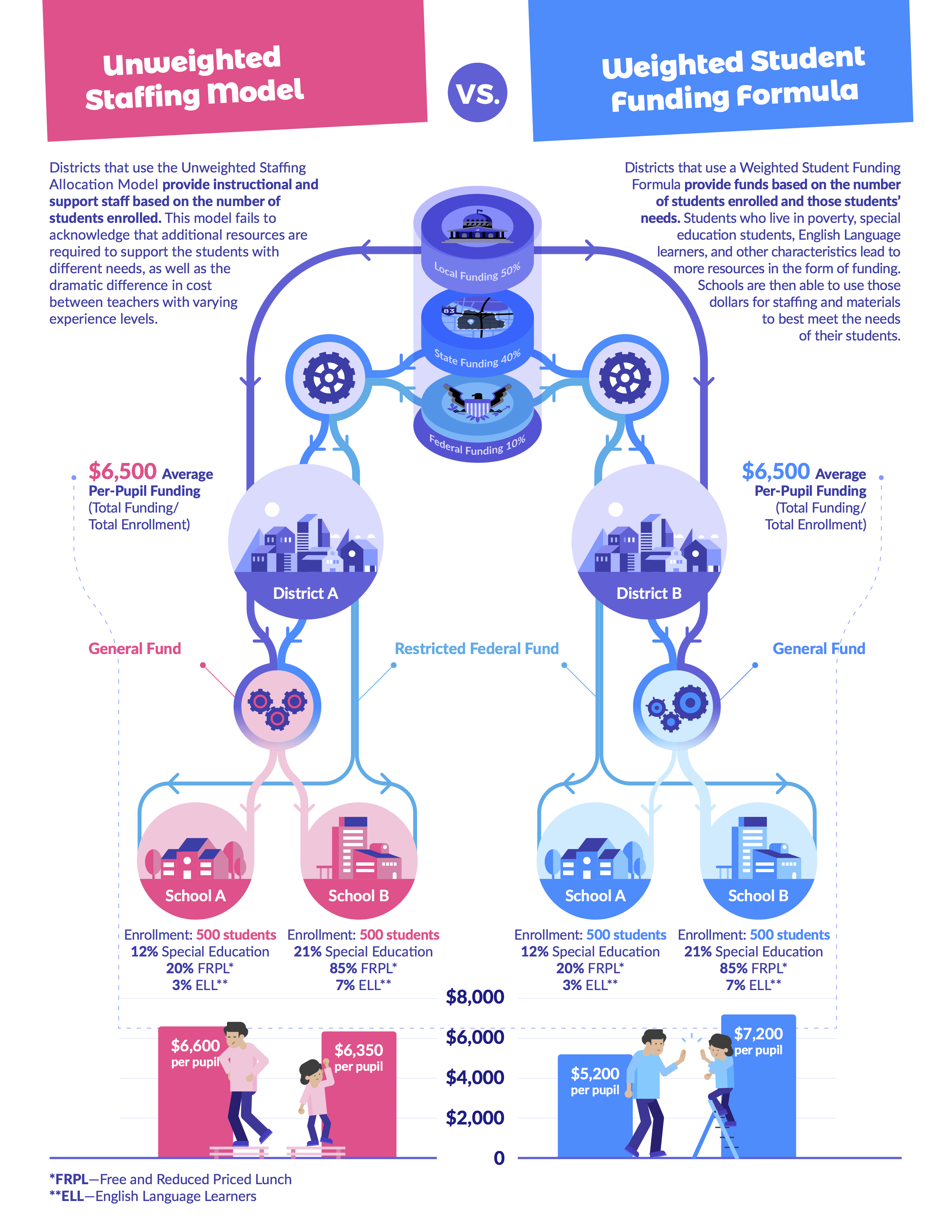

ABOUT THE AUTHOR
Jess Gartner is the founder and CEO of Allovue, where edtech meets fintech - #edfintech! Allovue was founded by educators, for educators. We combine powerful financial technology with education data, giving administrators the power to connect spending to student achievement. Jess has been featured as one of Forbes Magazine's 30 Under 30 in Education (2015, 2016 All-Star), The Baltimore Sun's Women to Watch (2013), and Baltimore Magazine's 40 Under 40 (2013). In 2014, she was recognized as the Maryland Smart CEO Innovator of the Year in the Emerging Business category. Before founding Allovue, Jess studied education policy at the University of Pennsylvania and taught in schools around the world, including Thailand, South Africa, Philadelphia, and Baltimore. She taught middle school humanities in Baltimore City and received her M.A. in teaching from Johns Hopkins University.
RELATED POSTS
equity-based budgeting: 5 questions to consider
meet amanda flurry: district partner
three faqs about esser funds
how to incorporate equity in staff- and student-based resource allocations
revising how your district allocates dollars to schools in 3 phases
where does education funding come from and how is it spent?
how to project funding models and enrollment within your district
meet laura nord: vp of sales
how design impacts your financial data
meet allovue: meghan stanton, account advisor
assess your k-12 financial planning systems during unpredictable times
what is your best quaran-complishment?
the cost of covid-19 for schools & families: part 3
the cost of covid-19 for schools & families: part 2
the cost of covid-19 for schools & families: part 1
behind the scenes of a recession in k12
trust, but verify: what to ask your finance team
safeguarding savings: tips to prepare for revenue reductions
how states count students to determine funding: a call for change
transparency & crisis management with superintendent mark schwarz
"i don't see what school finance has to do with equity."
guide to implementing priority-based budgeting in school districts
streamline district spending by offloading ineffectual programs
achieve district goals with strategic budgeting
meet allovue: jess gartner, ceo
is a student-based allocation funding formula right for your district?
what is zero-based budgeting?
survive district accounting system transitions with allovue
5 steps to transition your district to weighted student funding
meet allovue: jessica garrett, vice president of people
better data, better decisions: meet allovue power user, jordan ely
the future of education finance summit 2018: a recap
centralized vs. decentralized budgeting: strategies to advance equity
meet your k-12 budgeting season survival guide
go the extra mile: 3 ways to use essa report cards to improve schools
improve district financial transparency in five key areas
the a, b, cs of back to school finance
pop quiz: four questions to gauge per-pupil spending
meet allovue: brandyn bennett, software engineer
a day in the life: principal at center for inquiry school 70
using district peer comparisons to drive strategic action
what is the doed's student-centered funding system pilot?
successfully managing budget expenses throughout the year
meet allovue: maggie lubberts, director of product management
establishing financial accountability in your k-12 district
meet allovue: jake mauer, director of design
collaboration: the key ingredient to building & managing k-12 budgets
conducting mid year budgeting and spending reviews
meet allovue: jason becker, chief product officer
trick or treat? what's lurking in your school finances?
how are public schools funded?
meet allovue: cory edmonds, vp of district partnerships
implementing a new funding model in a k-12 district
the importance of personnel costs in deficit analysis
who has control of money in schools?
8 things to consider to improve your k-12 budgeting process
the future of education finance summit 2017: a recap
4 spending mistakes you're probably making at your school or district
understanding school district budget deficits
the 5ws of year end financial reviews
preparing k-12 district leadership for financial reporting under essa
3 steps to make your financial data essa-compliant
looking back to plan ahead
essa and fiscal equity
grant managers know best
school finance is a civil rights issue
4 ways to measure k-12 instructional program success
achieving equity using average teacher salary
top 10 things superintendents need to know about education finance
how student-based budgeting is revolutionizing special education
equity-based budgeting: 5 questions to consider
meet amanda flurry: district partner
three faqs about esser funds
how to incorporate equity in staff- and student-based resource allocations
revising how your district allocates dollars to schools in 3 phases
where does education funding come from and how is it spent?
how to project funding models and enrollment within your district
meet laura nord: vp of sales
how design impacts your financial data
meet allovue: meghan stanton, account advisor
assess your k-12 financial planning systems during unpredictable times
what is your best quaran-complishment?
the cost of covid-19 for schools & families: part 3
the cost of covid-19 for schools & families: part 2
the cost of covid-19 for schools & families: part 1
behind the scenes of a recession in k12
trust, but verify: what to ask your finance team
safeguarding savings: tips to prepare for revenue reductions
how states count students to determine funding: a call for change
transparency & crisis management with superintendent mark schwarz
"i don't see what school finance has to do with equity."
guide to implementing priority-based budgeting in school districts
streamline district spending by offloading ineffectual programs
achieve district goals with strategic budgeting
meet allovue: jess gartner, ceo
is a student-based allocation funding formula right for your district?
what is zero-based budgeting?
survive district accounting system transitions with allovue
5 steps to transition your district to weighted student funding
meet allovue: jessica garrett, vice president of people
better data, better decisions: meet allovue power user, jordan ely
the future of education finance summit 2018: a recap
centralized vs. decentralized budgeting: strategies to advance equity
meet your k-12 budgeting season survival guide
go the extra mile: 3 ways to use essa report cards to improve schools
improve district financial transparency in five key areas
the a, b, cs of back to school finance
pop quiz: four questions to gauge per-pupil spending
meet allovue: brandyn bennett, software engineer
a day in the life: principal at center for inquiry school 70
using district peer comparisons to drive strategic action
what is the doed's student-centered funding system pilot?
successfully managing budget expenses throughout the year
meet allovue: maggie lubberts, director of product management
establishing financial accountability in your k-12 district
meet allovue: jake mauer, director of design
collaboration: the key ingredient to building & managing k-12 budgets
conducting mid year budgeting and spending reviews
meet allovue: jason becker, chief product officer
trick or treat? what's lurking in your school finances?
how are public schools funded?
meet allovue: cory edmonds, vp of district partnerships
implementing a new funding model in a k-12 district
the importance of personnel costs in deficit analysis
who has control of money in schools?
8 things to consider to improve your k-12 budgeting process
the future of education finance summit 2017: a recap
4 spending mistakes you're probably making at your school or district
understanding school district budget deficits
the 5ws of year end financial reviews
preparing k-12 district leadership for financial reporting under essa
3 steps to make your financial data essa-compliant
looking back to plan ahead
essa and fiscal equity
grant managers know best
school finance is a civil rights issue
4 ways to measure k-12 instructional program success
achieving equity using average teacher salary
top 10 things superintendents need to know about education finance
how student-based budgeting is revolutionizing special education
Where Do Public Schools Get Their Money
Source: https://blog.allovue.com/how-are-public-schools-funded
Posted by: scullfliket61.blogspot.com
0 Response to "Where Do Public Schools Get Their Money"
Post a Comment